
Lighting is one of the biggest drivers of plant performance, and also one of the most misunderstood. If you’ve ever asked, “Is my PPFD too high?” or “How much DLI do my plants actually need?” you’re not alone.
PPFD and DLI are two of the most important lighting metrics in controlled environment agriculture, but they serve different purposes. Understanding how they work together is the key to dialing in your grow, improving yields, and avoiding wasted energy.
This guide breaks it all down in plain language, no PhD required.
What Is PPFD?
PPFD stands for Photosynthetic Photon Flux Density. It measures the amount of light hitting your plants every second.
- Measured in: µmol/m²/s
- What it tells you: Light intensity at the canopy level
Think of PPFD like the brightness of sunlight at a specific moment in time. A higher PPFD means more photons are reaching your plants right now.
Why PPFD Matters
PPFD directly affects:
- Photosynthesis rate
- Plant structure and morphology
- Stress response (too much light can be just as harmful as too little)
High-value crops like cannabis, leafy greens, and fruiting plants all have optimal PPFD ranges, and pushing beyond them doesn’t always mean better results.
What Is DLI?
DLI stands for Daily Light Integral. It measures the total amount of usable light your plants receive over an entire day.
- Measured in: mol/m²/day
- What it tells you: Total daily light exposure
If PPFD is how hard the sun is shining at noon, DLI is how much sunlight your plants receive from lights-on to lights-off.
Why DLI Matters
DLI influences:
- Overall growth rate
- Biomass accumulation
- Flowering and fruit development
Plants don’t just care about how bright the light is, they care about how much light they get over time.
PPFD vs DLI: What’s the Difference?
| Metric | Measures | Best For |
| PPFD | Instant light intensity | Fixture placement, uniformity, stress prevention |
| DLI | Total daily light | Crop planning, photoperiod strategy, yield optimization |
In short:
- PPFD = intensity
- DLI = accumulation
You can hit the right PPFD and still miss your DLI, and vice versa.
How PPFD and DLI Work Together
DLI is calculated using PPFD and photoperiod:
DLI = PPFD × hours of light per day
This means the same DLI can be achieved in different ways:
- Higher PPFD with a shorter photoperiod
- Moderate PPFD with a longer photoperiod
For example, a crop receiving 600 µmol/m²/s for 18 hours can achieve a similar DLI to one receiving 900 µmol/m²/s for 12 hours. The total light matters, but how you deliver it can affect plant stress, energy use, and operating costs.
Why Growers Need to Understand Both
Relying on only one metric often leads to issues:
- High PPFD, low DLI: Plants may look healthy short-term but underperform over time
- Low PPFD, high DLI: Plants may stretch or grow inefficiently
- Too much of both: Light stress, photoinhibition, and wasted electricity
The goal isn’t to maximize light, it’s to optimize it.
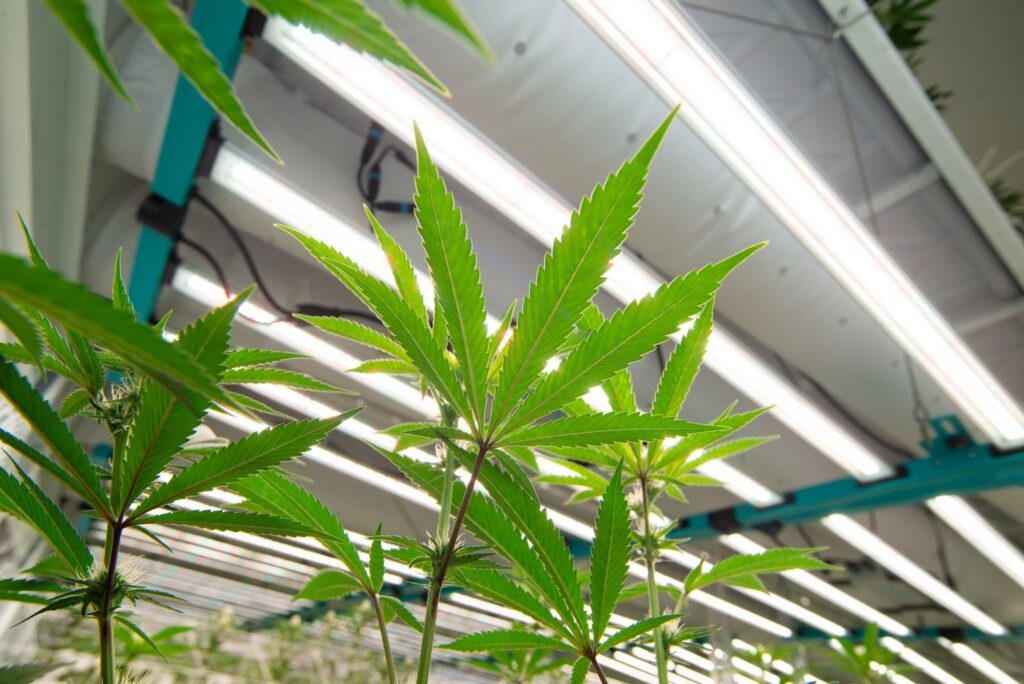
Typical PPFD & DLI Ranges by Crop Type
While exact targets vary by cultivar and environment, these general ranges are widely used in controlled environments:
Leafy Greens
- PPFD: 150–300 µmol/m²/s
- DLI: 12–17 mol/m²/day
Herbs
- PPFD: 200–400 µmol/m²/s
- DLI: 12–20 mol/m²/day
Fruiting Crops (Tomatoes, Peppers, Cucumbers)
- PPFD: 400–700 µmol/m²/s
- DLI: 20–30 mol/m²/day
Cannabis (General Guidelines)
- Vegetative Stage:
- PPFD: 400–600 µmol/m²/s
- DLI: 20–30 mol/m²/day
- Flowering Stage:
- PPFD: 600–1200+ µmol/m²/s
- DLI: 30–50+ mol/m²/day
These ranges assume proper CO₂ levels, temperature, nutrition, and irrigation. Lighting performance never exists in isolation.
The Role of Photoperiod
Photoperiod, the number of hours lights are on each day, connects PPFD and DLI.
Longer photoperiods allow growers to:
- Use lower PPFD
- Reduce fixture intensity
- Improve energy efficiency in some environments
Shorter photoperiods often require:
- Higher PPFD
- Tighter fixture spacing
- More attention to heat and plant stress
Balancing intensity and duration is critical for long-term crop health.
How Fixture Design Impacts PPFD and DLI
Not all LED fixtures deliver light the same way. Two fixtures with identical wattage can produce very different PPFD maps.
Important factors include:
- Optical design
- Diode placement
- Mounting height
- Beam angle
- Canopy uniformity
Poor distribution can result in:
- Hot spots that stress plants
- Shaded zones that underperform
- Inconsistent crop quality
Measuring PPFD across multiple canopy points gives a much clearer picture than relying on a single reading.
Measuring PPFD and DLI Accurately
Accurate measurements lead to better decisions.
Measuring PPFD
- Use a calibrated quantum sensor
- Measure at canopy height
- Take multiple readings across the grow area
Measuring DLI
- Calculate using PPFD and photoperiod
- Or use a data logger that tracks daily light accumulation
Consistency in measurement timing and location is key.
Common PPFD and DLI Mistakes
Even experienced growers can run into issues:
Chasing Maximum PPFD
More light isn’t always better. Plants reach a saturation point where additional photons provide diminishing returns.
Ignoring Growth Stages
Seedlings, vegetative plants, and flowering crops all require different light levels.
Overlooking Uniformity
Average PPFD values can hide problem areas within the canopy.
Not Adjusting for CO₂
Higher PPFD levels often require elevated CO₂ to remain efficient.
PPFD, DLI, and Energy Efficiency
Lighting is one of the largest operational costs in indoor agriculture.
Optimizing PPFD and DLI can:
- Reduce unnecessary energy use
- Improve grams-per-watt performance
- Lower cooling loads
- Extend fixture lifespan
Smart lighting strategies focus on efficiency, not just output.
Designing a Lighting Strategy That Works
Successful lighting design starts with the crop, not the fixture.
Ask:
- What DLI does this crop require?
- What PPFD range supports healthy growth?
- How does photoperiod affect total light delivery?
- Is canopy coverage uniform?
From there, fixture selection and layout can be optimized to meet those goals.
PPFD vs DLI: The Bottom Line
PPFD and DLI aren’t competing metrics, they’re complementary tools.
- PPFD tells you how intense your light is
- DLI tells you how much light your plants receive each day
Understanding both leads to better decisions, healthier crops, and improved ROI.
Frequently Asked Questions
What is the difference between PPFD and DLI?
PPFD measures instantaneous light intensity at the plant canopy, while DLI measures total light received over a full day.
Is PPFD or DLI more important?
Both are equally important. PPFD controls intensity, while DLI determines total light exposure.
Can I increase DLI without increasing PPFD?
Yes. Increasing photoperiod raises DLI even if PPFD stays the same.
What happens if PPFD is too high?
Excessive PPFD can cause light stress, reduced efficiency, and plant damage, especially without increased CO₂.
How do I calculate DLI?
DLI is calculated using PPFD multiplied by the number of light hours per day, converted into mol/m²/day.
Does DLI matter in greenhouses?
Yes. Total daily light exposure matters whether light comes from the sun, LEDs, or both.
Should PPFD and DLI change throughout the grow cycle?
Absolutely. Different growth stages have different lighting requirements.
What now?
Dialing in PPFD and DLI isn’t about pushing more light, it’s about delivering the right light, at the right time, for your crop and environment. With the right data and a thoughtful lighting strategy, growers can improve consistency, efficiency, and long-term performance. If you’re looking to fine-tune your lighting approach or better understand what your plants actually need, it starts with asking the right questions. See how we can help you.