When BIOS founder and chief scientist Robert Soler worked at NASA’s Space Life
Sciences Lab, the questions he needed to answer weren’t theoretical. They were
about survival.
How do you grow food in space? How do you simulate Earth’s day-night cycles in a
sealed, metal capsule orbiting the planet? How do you design lighting that doesn’t
just illuminate, but actively supports biological life?
These are the same principles Soler brought back to Earth—and built into BIOS
Lighting. Today, those lessons shape how the company designs lights, supports
growers, and helps facilities operate with more precision and less guesswork.
Here are five core ideas from NASA that still guide how BIOS builds.
1. Lighting Is About Biology
In low-light environments like Mars or the moon, you don’t use lighting just so
astronauts can see. You use it to regulate their circadian rhythms, support plant
development, and simulate seasons in a space that has none.
That mindset still drives BIOS.
“Lighting can do more than help you see,” Robert says. “It can support circadian
rhythms, mood, and plant morphology. The right spectrum can simulate seasons,
enhance growth, and even impact aroma.”
BIOS lights are tuned with that biological precision. Energy efficiency is important,
and so are outcomes.
2. Show the Data
Robert puts it plainly: “One thing that always stuck with me at NASA was the saying:
In God we trust, all others bring data.”
It’s a guiding principle for BIOS.
In a market full of slider bars and marketing buzzwords (UV! Far-red! Spectral
customization!), BIOS stays focused on evidence. If a new feature doesn’t move the
needle for plant performance—or creates more complexity than value—it doesn’t
make the cut.
UV lighting, for example, has gotten a lot of attention. But the science is mixed, and
the engineering tradeoffs are real. As Robert puts it, “If there’s a scientific reason to
try something, we’ll investigate it. But it has to pass both the science test and the
engineering test. Otherwise, it’s just adding cost and complexity for no reason.”
3. Build for the Long Haul
You can’t swap out light fixtures on the International Space Station. They have to
work. Period.
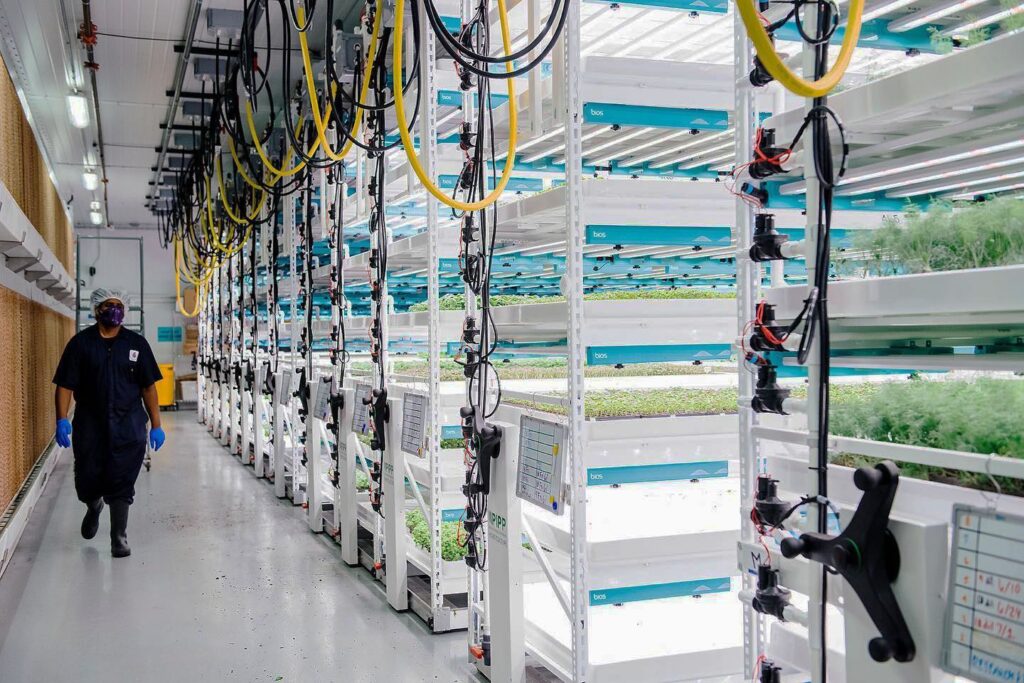
That durability-first design ethos is core to how BIOS builds every fixture.
“We design our lights to last as long as the facility does,” Robert says. “They’re not like
the bulbs you buy at Home Depot—those are built to fail after a year. We don’t think
that’s sustainable.”
One grower ran a side-by-side trial years after installing BIOS fixtures. The older BIOS
units still outperformed brand-new competitor lights. That’s not marketing spin—it’s
the result of diode quality, thermal management, and engineering-grade materials
that were never designed to cut corners.
4. Complexity Is a Liability
NASA missions don’t tolerate unnecessary tech. Every extra toggle or tool is another
point of failure.
BIOS brings that same thinking into the grow room. While other manufacturers pile
on the features—adjustable spectrum, multi-zone dials, custom tuning—BIOS opts
for clarity.
“You can always add complexity,” Robert says. “But every knob is something else to
break or misconfigure. Our goal is to give growers what they need without
overwhelming them with tech that adds more confusion than value.”
That simplicity is especially important for facilities transitioning from HPS to LEDs.
BIOS makes the shift easier, faster, and far less error-prone—no steep learning curve
required.
5. The Most Advanced Tech Still Has to Serve People
The last lesson is the simplest—and the one that defines how BIOS works with
growers: be the partner you’d want in your own corner.
Robert tells the story of a facility that kept experiencing strange voltage fluctuations
due to dirty power in the industrial zone. It wasn’t BIOS’s fault. But instead of walking
away, BIOS jumped in—helped condition the power, troubleshoot the issue, and
stabilize the system.
“That’s how we’re built,” Robert says. “Not just solving problems, but being the kind
of partner growers want in their corner long-term.”
The Takeaway
BIOS didn’t set out to become just another lighting company. Their foundation is
aerospace. But their mission is grounded: deliver reliable outcomes for growers, day
in and day out.
That means biologically intelligent lights. Simple deployment. Long-term support.
And a mindset built not around features—but around function.
Growing smarter starts with asking better questions. That’s what NASA taught. And
it’s what BIOS is still doing—fixture by fixture, grow by grow.