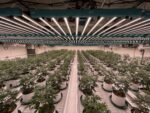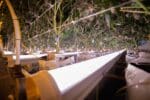

Inside Bosky Genetics’ Third Harvest with BIOS Under Canopy Lights
When a cultivation team has to run out and buy extra totes mid-harvest, you know something is working.
At Bosky Genetics, the third harvest since implementing BIOS under canopy lighting told a clear story: more flower, more usable product, and more operational pressure, in a good way.
“We had to go buy more totes yesterday,” the team shared. “We’re literally making room to hold more flower.”
For commercial cultivators, that’s not hype. That’s logistics shifting in real time because production increased.
Let’s break down what changed, and why it matters.
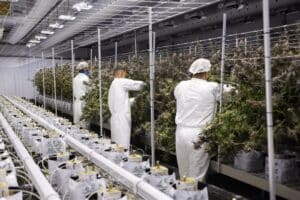
From Top-Heavy Yields to Full-Plant Productivity
One of the most telling results came from a recent harvest.
- Wet weight per plant: ~3,300 grams
- Increase over previous runs: Nearly +1,000 grams per plant
- Not just top colas; the lower canopy improved significantly
That kind of lift doesn’t come from simply adding more light at the top. It comes from addressing one of the most common inefficiencies in indoor cannabis cultivation: underutilized lower canopy zones.
Before under canopy lighting, much of the plant’s lower growth either:
- Produced small, airy buds
- Fell into trim or extraction grade
- Required aggressive lollipopping to redirect energy upward
Now?
“All the way down to the lowest pieces on this plant are just amazing usable products.”
That shift from selective top-heavy quality to full vertical canopy quality is where the real gains are hiding.

The Under Canopy Difference
Traditional overhead lighting systems focus the majority of photon density on the top canopy. While that drives strong apical growth, it often leaves lower bud sites light-starved.
Under canopy lighting changes the distribution strategy.
Instead of asking photons to fight through dense foliage, supplemental light is delivered directly to:
- Lower bud sites
- Interior nodes
- Shaded branches
The result is more uniform PPFD distribution throughout the plant structure.
At Bosky Genetics, the impact wasn’t subtle.
- Increased wet weight
- Improved usable biomass throughout the plant
- Consistency across strains
“You know, we’re seeing it with every strain we’re running right now.”
When improvements replicate across genetics, that’s not strain luck, that’s system-level optimization.
Quality Across the Board
Yield increases get attention. But quality determines long-term viability.
Bosky reported that overall flower quality improved, not just volume.
That typically points to:
- Better bud density at lower sites
- Improved terpene retention due to healthier light distribution
- More consistent maturation throughout the plant
When lower buds stop being larf and start being saleable, grading improves, processing becomes more efficient, and labor per pound drops.
That’s operational ROI not just agronomic ROI.
Harvest Logistics: A Good Problem to Have
The practical effect of higher output?
They ran out of storage.
The team had to:
- Purchase additional totes
- Reorganize storage space
- Increase dry room flow
And this was only the third harvest since implementing under canopy lighting.
In commercial environments, facility design often assumes predictable yield outputs. When production increases by meaningful margins, it impacts:
- Storage planning
- Dry room throughput
- Trimming labor
- Packaging schedules
If your lighting system changes your harvest logistics, that’s a serious performance indicator.
Why the Third Harvest Matters
First harvest results can be influenced by learning curves.
Second harvest validates repeatability.
Third harvest confirms sustainability.
By the third cycle, cultivation teams have:
- Dialed environmental controls
- Adjusted irrigation strategies
- Optimized plant training under the new lighting configuration
At Bosky Genetics, results didn’t plateau after implementation; they stabilized and continued delivering.
That’s what separates a short-term bump from a structural improvement in production.
The Bigger Picture: Unlocking the Lower 40%
In many indoor cannabis facilities, the lower 30–40% of the plant contributes disproportionately less to final yield value.
Without adequate light:
- Buds stay underdeveloped
- Biomass requires removal
- Energy efficiency per square foot drops
Under canopy lighting targets that inefficiency directly.
Instead of increasing fixture intensity overhead (which can:
- Disproportionately raise HVAC demand
- Increase leaf temperature
- Risk light stress at the top
Supplemental under canopy lighting redistributes usable photons where they were previously missing.
The effect is a more balanced plant architecture and higher usable biomass per square foot.
At Bosky Genetics, that translated into nearly 1 kilogram more wet weight per plant.
Operational Confidence
“It’s a lot to be happy for right now.”
That kind of statement from a cultivation team matters. Growers are typically cautious about praise. When they’re excited, it’s because the numbers are undeniable.
Across strains, across cycles, and across the entire canopy profile, the improvements were visible.
And visible improvements are easier to manage than theoretical ones.
What This Means for Commercial Cultivators
If you’re evaluating under canopy lighting, Bosky Genetics’ results highlight a few key considerations:
1. Measure Whole-Plant Yield, Not Just Top Cola Weight
Track wet weight and dry weight across the full canopy profile.
2. Evaluate Grade Distribution
Has your percentage of A-grade flower increased from lower sites?
3. Monitor Labor Efficiency
Are you spending less time removing unusable lower growth?
4. Prepare for Output Increases
If your yields jump, can your dry room, storage, and post-harvest workflows handle it?
Lighting upgrades don’t just change plants, they change operations.
Frequently Asked Questions (FAQ)
What is under canopy lighting in cannabis cultivation?
Under canopy lighting refers to supplemental LED fixtures placed beneath the plant canopy to deliver light directly to lower bud sites and interior nodes that receive minimal overhead light.
Does under canopy lighting increase yield?
Based on results from Bosky Genetics, under canopy lighting contributed to a 25% increase in dried flower. Yield improvements depend on facility design and cultivation practices, but can be significant when lower canopy zones are underperforming.
Does it improve flower quality or just quantity?
Bosky Genetics reported improvements in usable product throughout the plant, not just increased biomass. Lower buds showed better density and consistency.
Is under canopy lighting strain-specific?
At Bosky Genetics, improvements were observed across multiple strains, not just one cultivar. Performance will vary depending on plant structure and canopy density.
Will under canopy lighting increase HVAC demand?
Because under canopy lighting redistributes photons rather than dramatically increasing overhead intensity, facilities may avoid disproportionate HVAC spikes that come from simply raising top-light power. However, total electrical load should still be evaluated.
How soon can results be measured?
Yield and quality differences can be measured in the first harvest cycle, but third-cycle results like those at Bosky Genetics help confirm repeatability and operational stability.
Final Thoughts
When a cultivation team has to expand storage because harvest volumes increased, that’s not a marketing claim, it’s an operational shift.
At Bosky Genetics, three harvests in, the results are clear:
- Higher wet weights
- More usable lower canopy flower
- Improved consistency across strains
- Increased overall production volume
Under canopy lighting isn’t about replacing top lighting, it’s about unlocking the portions of the plant that were previously underperforming.
And sometimes, the clearest sign it’s working…
is when you need more totes.
Ready to maximize your canopy’s full potential? Discover how BIOS under canopy lighting can transform your yields, improve bud quality, and optimize every square foot of your grow. Contact us today to see how your facility can benefit from smarter lighting.