The use of LED grow lights in commercial agriculture has drastically shifted over the past decade; spectrum strategy is no longer just about “red and blue.” Today’s growers are optimizing across PAR, ePAR, UV, and far-red, fine-tuning spectrum recipes to influence morphology, yield, potency, and crop uniformity.
But with more data comes more confusion.
This guide breaks down:
- How commercial lighting differs from hobby setups
- What grow light spectrum actually means
- How different wavelengths affect plant growth
- what “full spectrum” means in 2026
- How spectrum impacts cannabis production
What is Grow Light Spectrum?
Grow light spectrum refers to the range of electromagnetic wavelengths emitted by a lighting fixture that influences plant growth.
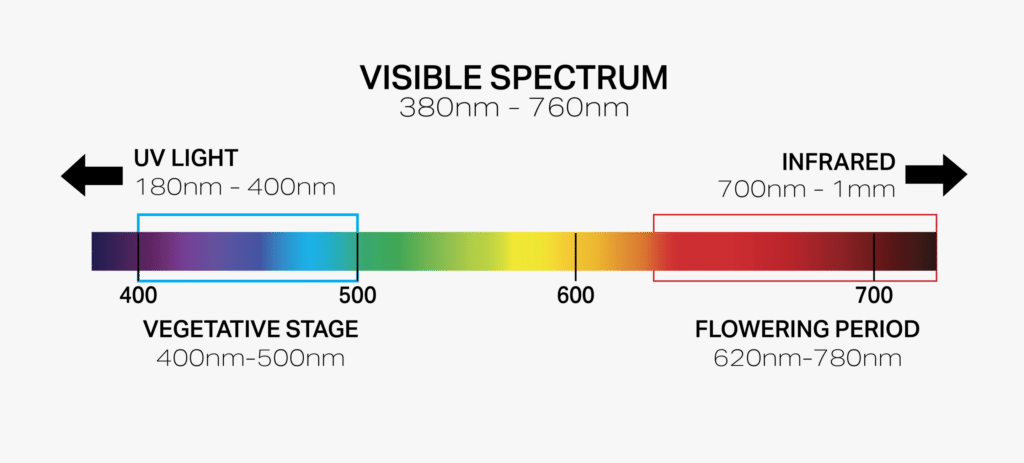
Traditionally, growers focused on PAR (Photosynthetically Active Radiation) light between 400–700 nanometers (nm). This range includes:
- Blue (400–500 nm)
- Green (500–600 nm)
- Red (600–700 nm)
However, modern research has expanded this understanding to include ePAR (extended PAR), 400–750 nm, recognizing the measurable photosynthetic contribution of far-red light (700–750 nm).
While humans see roughly 380–740 nm as visible light, plants detect and respond to:
- UV (below 400 nm)
- PAR (400–700 nm)
- Far-red (700–750+ nm)
Different wavelengths trigger different physiological responses, influencing:
- Secondary metabolite production (like cannabinoids or terpenes)
- Photosynthesis rate
- Stem elongation
- Leaf expansion
- Flowering timing
How Photosynthesis Responds to the Spectrum
Chlorophyll a and b absorb light most efficiently in the blue (~450 nm) and red (~660 nm) regions. That’s why early LED systems heavily emphasized those peaks.
But modern research shows:
- Green light penetrates deeper into the canopy, driving lower-leaf photosynthesis.
- Far-red enhances photosynthetic efficiency when paired with red light (Emerson Enhancement Effect).
- Balanced white-spectrum LEDs often outperform narrow-band “blurple” fixtures in commercial settings.
In short, photosynthesis is more complex than just red and blue.
What Does “Full Spectrum” Mean?
In 2026, full spectrum generally refers to a sunlight-like white spectrum that spans 400–750 nm, often with optional UV and far-red channels.
Unlike early-generation LEDs, modern commercial fixtures:
- Deliver high PPE (Photosynthetic Photon Efficacy)
- Provide uniform canopy coverage
- Allow spectrum tuning (in some systems)
- Integrate with environmental controls
Full-spectrum lighting improves:
- Visual crop inspection
- Worker comfort
- Canopy penetration
- Crop uniformity
And in commercial facilities, spectrum is now part of an integrated strategy alongside PPFD, DLI, photoperiod, CO₂, irrigation, and HVAC.
Spectrum Breakdown by Wavelength
UV Light (100–400 nm)
Types:
- UV-A (315–400 nm)
- UV-B (280–315 nm)
- UV-C (100–280 nm, rarely used in grow rooms)
Controlled UV exposure may:
- Increase anthocyanin expression (coloration)
- Influence terpene profiles
- Support pathogen management strategies
In Cannabis cultivation, small doses of UV-B are sometimes used to potentially influence cannabinoid expression. However, overdosing UV can reduce yield and damage tissue.
Blue Light (400–500 nm)
Blue light:
- Promotes compact growth
- Strengthens stems
- Increases stomatal conductance
- Supports early vegetative development
Higher blue ratios reduce stretch and improve structural integrity. In leafy greens, blue light also influences pigmentation and nutritional quality.
Too much blue, however, can suppress extension growth and reduce total biomass in flowering crops.
Green Light (500–600 nm)
Once underestimated, green light is now recognized as:
- Highly penetrative through dense canopies
- Important for lower-leaf photosynthesis
- Supportive of balanced morphology
In indoor vertical farms, green wavelengths help distribute usable light deeper into stacked crop layers.
In greenhouses, supplemental green may be less critical due to natural sunlight contribution.
Red Light (600–700 nm)
This light remains one of the most photosynthetically efficient bands.
Red light:
- Drives biomass accumulation
- Promotes flowering
- Encourages leaf expansion
- Supports vegetative mass
However, high red without sufficient blue can cause excessive stretch.
Modern full-spectrum LEDs incorporate red peaks within balanced white light to avoid morphological distortion.
Far-Red (700–750+ nm)
Far-red is now widely accepted as part of usable photosynthetic radiation (ePAR).
It influences:
- Flowering initiation
- Shade avoidance response
- Stem elongation
- Emerson Enhancement Effect (boosted efficiency when paired with red)
In short-day crops like Cannabis, 730 nm pulses at end-of-day may accelerate flowering response.
Used strategically, far-red can improve canopy structure and yield, but misused, it can lead to unwanted stretching.
Spectrum alone does not determine yield. It must be aligned with:
Lighting is part of a holistic cultivation system.
Finding the Right Spectrum Strategy
Since the shift in lighting started, successful growers focus on:
- High-efficiency full-spectrum white fixtures
- Proper PPFD targeting
- Optimized DLI for crop type
- Strategic use of far-red and UV
- Uniform canopy coverage
Rather than chasing extreme red/blue ratios, modern cultivation favors balanced, research-driven spectrum recipes that mimic and improve upon natural sunlight.
At BIOS, LED systems are designed using current horticultural science to give commercial growers precision control over spectrum, intensity, and uniformity, helping optimize yield, quality, and operational efficiency.
Ready to take your grow to the next level? Get a free light plan to see how we can help you.
Frequently Asked Questions (AEO-Optimized)
What is the best light spectrum for plant growth?
There is no single “best” spectrum. Most plants perform best under a balanced full-spectrum white light (400–750 nm) with sufficient red and moderate blue. Adjustments depend on crop type and growth stage.
Is red or blue light better for plants?
Both are essential. Blue light supports structural growth and compact morphology, while red light drives biomass and flowering. Optimal growth requires a balance of both.
Do plants use far-red light for photosynthesis?
Yes. Modern research recognizes far-red (700–750 nm) as contributing to photosynthesis, especially when combined with red light (Emerson Enhancement Effect).
Does UV light increase THC in Cannabis?
Some studies suggest controlled UV-B exposure may influence cannabinoid production, but results vary. Overexposure can damage plants and reduce yield.
What spectrum is best for Cannabis flowering?
During flowering, Cannabis typically benefits from:
- High red intensity
- Balanced white spectrum
- Strategic far-red application
- High PPFD and optimized DLI
Exact ratios vary by cultivar and facility conditions.
How important is spectrum compared to PPFD?
Both matter. Spectrum influences plant form and development, while PPFD determines how much usable light energy the plant receives. You need both optimized for maximum performance.