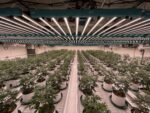

For decades, indoor cultivation lighting has revolved around the concept of PAR—Photosynthetically Active Radiation—defined as the range of light wavelengths from 400 to 700 nanometers that drive photosynthesis. PAR has been a bedrock for light measurement tools, lighting design, and fixture development.
But as plant science evolves, so does our understanding of what light really matters. It turns out, plants don’t stop responding at 700 nm—and for cannabis cultivators seeking to fine-tune production quality and yield, this insight changes the game.
Enter ePAR: Extended PAR, a new measurement standard that stretches up to 750 nm to include far-red light.
This is a practical shift that allows growers to align their lighting strategies with more complete biological truths.
Why the Shift Matters
Cannabis doesn’t photosynthesize in a vacuum. Its response to light is nuanced and complex, governed by multiple photosystems, photoreceptors, and developmental cues. While PAR-based lighting served well for early LED adoption, it left out a key portion of the spectrum—far-red light (700–750 nm)—that contributes to both photosynthetic efficiency and morphological regulation.
The shift from PAR to ePAR matters because:
- Photosynthesis doesn’t stop at 700 nm: Research has shown that far-red photons can drive photosynthetic activity when combined with red light, a concept known as the Emerson Enhancement Effect.
- Far-red influences plant structure: Through interactions with phytochromes, far-red regulates internodal spacing, flower initiation, and even pigmentation.
- Cannabis responds strongly to spectral balance: Especially during flowering, when developmental cues are sensitive to light ratios, the presence (or absence) of far-red light can impact density, resin production, and finish quality.
In short: if your light spectrum ignores far-red, you’re missing part of the photosynthetic and hormonal equation. The Bridge was designed specifically to address the exact shortcoming.
First, a bit of emerging research to help us understand what that means.
What Is ePAR?
ePAR stands for Extended Photosynthetically Active Radiation and covers wavelengths from 400 to 750 nm. It includes everything in the traditional PAR range, but also accounts for far-red light, which plays an increasingly recognized role in plant energy use and development.
Originally, the 700–750 nm range was excluded from PAR definitions because early studies suggested these longer wavelengths were inefficient at driving photosynthesis in isolation. But more recent work has shown that far-red photons significantly boost total photosynthetic output when paired with red light, due to their stimulation of Photosystem I activity.
For growers, this means that any lighting strategy based solely on PAR might be leaving photosynthetic performance—and ultimately yield—on the table.
Most grow lights stop at 700 nm—cutting off part of the biological response curve. The Bridge is engineered to deliver targeted far-red output (700–750 nm), unlocking the benefits of ePAR with precision. It supports dual photosystem activation for improved photosynthesis and leverages far-red’s influence on morphology, helping cultivators control stretch, flower timing, and visual expression.
For growers transitioning from HPS or looking to maximize flower quality, The Bridge ensures your spectrum speaks your plants’ full biological language.
Benefits of ePAR for Cannabis Cultivation
ePAR tends to be a more accurate benchmark for photosynthetic activity. Cannabis cultivators who incorporate this extended spectrum gain:
- More Complete DLI Calculations: Traditional DLI (Daily Light Integral) tools that measure only PAR may underestimate total usable photons reaching the canopy. ePAR-based tools capture a fuller picture of light available for plant metabolism.
- Improved Spectrum Matching for Developmental Stages: ePAR supports spectrum optimization for specific growth phases:
- Vegetative: Limit far-red to control stretch and maintain tight internodes.
- Flowering: Introduce far-red strategically to enhance flower expansion, trichome production, and visual finish.
- Vegetative: Limit far-red to control stretch and maintain tight internodes.
- More Controlled Morphogenesis: By managing the red:far-red ratio, cultivators can regulate key morphological traits—such as plant height, canopy density, and flowering initiation timing. A high red:far-red ratio suppresses stretching; a lower ratio can trigger flowering and boost calyx development.
- Improved Energy Efficiency: Because far-red photons have longer wavelengths, they carry less energy per photon, but are used efficiently when paired with red light. This means more grams per joule, especially when delivered in balance.
How BIOS Lighting Integrates ePAR
At BIOS, lighting design begins with plant biology, not just engineering specs.
Unlike many off-the-shelf lights that treat far-red as an afterthought, BIOS Lighting’s fixtures are calibrated for:
- Balanced photon flux: Maintain the optimal red:far-red ratio to enhance photosynthesis while managing morphology.
- Precision control: Enable growers to replicate specific outcomes across cycles and cultivars, with the new Bridge fixture, for example, using far-red as a repeatable environmental signal.
This makes BIOS fixtures ideal for cultivators who want both scientific rigor and production flexibility.
Practical Takeaways for Growers
Understanding ePAR is the first step. Applying it requires thoughtful integration into your grow strategy.
Here’s where to start:
- Ask lighting vendors about ePAR coverage. If a fixture still measures only PAR, you’re not getting the full story on plant-impacting photons.
- Watch your red:far-red ratio. This ratio—not just raw intensity—drives the biggest morphological effects. A typical flowering ratio might hover around 3:1 or 4:1, but genetics will vary.
- Monitor irrigation and VPD. Increased far-red boosts photosynthetic rates and transpiration, which in turn affects water demand and vapor pressure deficit. Be ready to recalibrate your climate control.
- Time far-red strategically. In many cases, far-red is best applied at the end of the day or during late flowering for morphology and pigmentation without triggering excess elongation.
Conclusion
ePAR is the next generation of light science for advanced cannabis cultivation. As the cannabis industry matures, precision lighting becomes a competitive edge, not a luxury. ePAR-based systems enable cultivators to garner the most effective light recipes for yield, quality, and consistency, all while maximizing energy ROI.
By moving beyond outdated PAR-only paradigms and embracing the science of full-spectrum plant response, growers can unlock higher-performing plants and smarter environmental control.
The Bridge is built for growers who want more from their lights. It includes far-red wavelengths that older PAR systems leave out—giving your plants the full spectrum they actually use. That means better yields, more consistent quality, and smarter energy use. As growers push for tighter control and better results, lights like The Bridge offer a clear edge.
As BIOS Grow Lights’ work shows, the future of cannabis lighting is already here—it’s just a little redder.